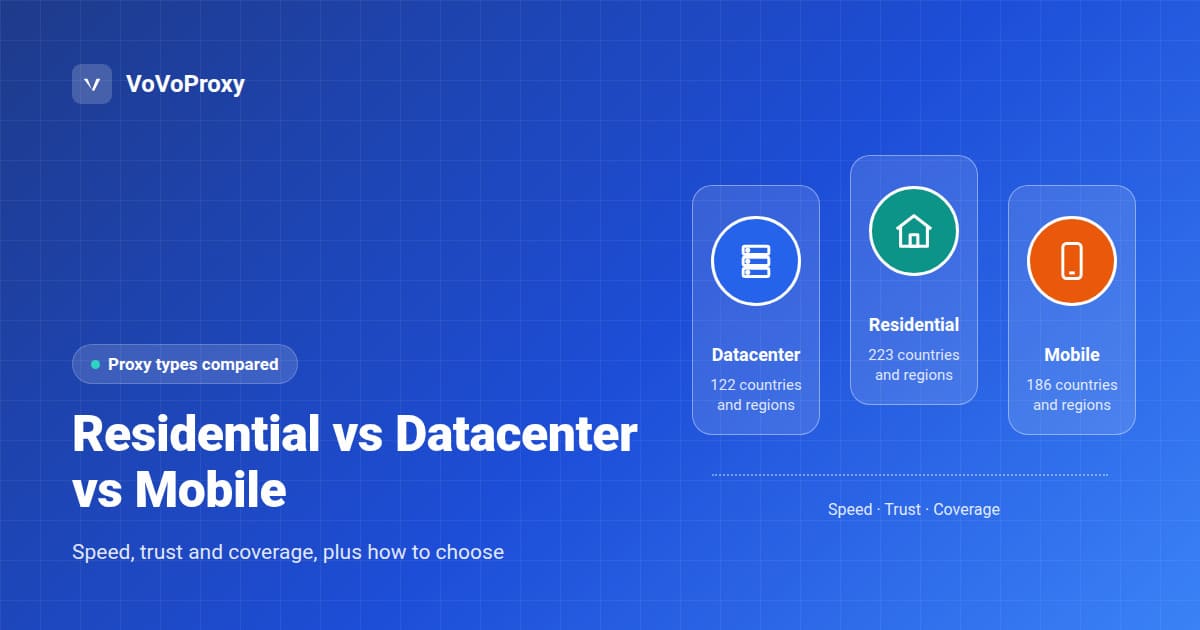
Residential vs Datacenter vs Mobile Proxies: Which One Do You Need?
If you are comparing residential vs datacenter proxies, and wondering where mobile proxies fit in, you are really asking one question: which IP type gives you accurate results for your workload?
There is no single "best" proxy. Datacenter proxies win on throughput and consistency. Residential proxies win when you need to see the web the way local households see it. Mobile proxies win when the experience you are testing happens on mobile networks. A higher-trust premium residential tier sits on top for sensitive verification.
This guide explains how each type works, compares them on speed, trust and workload fit, and gives you a practical framework for choosing.
The Three Main Types of Proxies at a Glance
A proxy sits between your client and the website you request. The destination sees the proxy's IP address instead of yours. What changes between the types of proxies is where that IP address comes from, and that origin shapes how destinations treat your traffic.
| Datacenter | Residential | Mobile | |
|---|---|---|---|
| Where the IP comes from | Server infrastructure in data centers | Residential networks (household connections) | Mobile carrier networks |
| Main strength | High throughput and stable sessions | Real-user perspective, location-level targeting, broad geographic coverage | Mobile network perspective, location targeting |
| Best suited for | Data collection, monitoring, automated testing | Localization checks, ad verification, market research | Mobile app QA, mobile-first verification, mobile network testing |
| Main trade-off | Easier for sites to recognize as non-household traffic | Smaller, more selective pool | Best suited to mobile-first experiences |
The short version: start with the type that returns accurate results for your targets, and move up only when you have evidence you need to.
Datacenter vs Residential Proxies: How They Differ
This is the comparison most buyers start with, because the two types sit at opposite ends of the cost and realism spectrum.
Datacenter proxies: speed and cost efficiency
Datacenter proxies use IP addresses hosted on server infrastructure. Because that infrastructure is built for bandwidth, datacenter proxies are usually the fastest and most predictable option.
When datacenter proxies are the right call
- Large-scale data collection from public pages that do not vary by visitor type.
- Uptime and performance monitoring, where you need frequent, consistent requests.
- Automated testing of your own web properties, staging environments or APIs from different regions.
- Any job where volume dominates the budget and the target does not treat server traffic differently.
Where datacenter proxies fall short
Datacenter IP ranges are publicly associated with hosting providers, so websites can easily recognize them as non-household traffic. Some sites show different content, stricter limits, or simplified pages to that traffic. If the point of your job is to see exactly what a consumer sees, datacenter results may not be representative.
VoVoProxy's Datacenter proxies are the natural starting point for high-volume, low-sensitivity workloads.
Residential proxies: the real-user perspective
Residential proxies route requests through IP addresses associated with residential networks. To the destination, the request looks like it comes from an ordinary household in a specific location. That makes residential proxies the default for anything location-dependent.
When residential proxies are the right call
- Localization checks: confirm language, currency, pricing and content for each market.
- Ad verification: see which ads, creatives and landing pages appear for users in a given region.
- Market research: collect public pricing and assortment data the way local shoppers see it.
- Local search results: search rankings often vary by city, so location-level targeting matters.
With VoVoProxy, targeting is available by country, city, state or ASN, depending on the pool, and US, UK and Germany are available across pools. Both rotating IPs and sticky sessions are supported, so you can sample many addresses or hold one IP through a multi-step flow.
Where residential proxies fall short
Residential throughput is typically less predictable than server infrastructure, and the pool is more selective. For bulk jobs against targets that do not care about IP type, datacenter is the more practical fit.
VoVoProxy's Residential proxies are billed per whole GB with a 1 GB minimum, prepaid and with no subscription.
The premium residential tier
Some verification work is too sensitive for a standard pool: brand protection evidence, compliance screenshots, or high-value ad spot checks where an inconsistent result costs real money. For those cases, a higher-trust pool is worth choosing. VoVoProxy's Premium Residential proxies are aimed at lower-volume, high-stakes checks.
Mobile vs Residential Proxy: What Is the Difference?
The mobile vs residential proxy question comes up often, because both offer a "real user" perspective. The difference is the network.
Mobile proxies route traffic through IP addresses on mobile carrier networks, the same kind of connection a phone uses on cellular data. Residential proxies route through household connections. Some websites and apps behave differently for mobile network traffic: they may serve mobile-specific content, different ad inventory, or a different flow entirely.
When mobile proxies are the right call
- Mobile app QA: test how your app's backend, content and geo features behave for users on mobile networks.
- Mobile-first verification: confirm that mobile ads, app-store pages or mobile landing pages render correctly in each market.
- Mobile network testing: check performance and behavior over carrier connections in specific locations.
When residential is enough
If you only need a consumer perspective in a given location, and the experience does not change between home broadband and cellular, residential is usually the better fit. Use mobile when the mobile network itself is part of what you are testing.
VoVoProxy's Mobile proxies support location targeting and are billed per GB with no subscription.
Speed, Trust and Workload Fit Compared
The three dimensions that matter most when choosing are speed (throughput and consistency), trust (how closely traffic resembles ordinary consumer traffic from the destination's point of view), and workload fit. The matrix below shows the typical relative position of each pool.
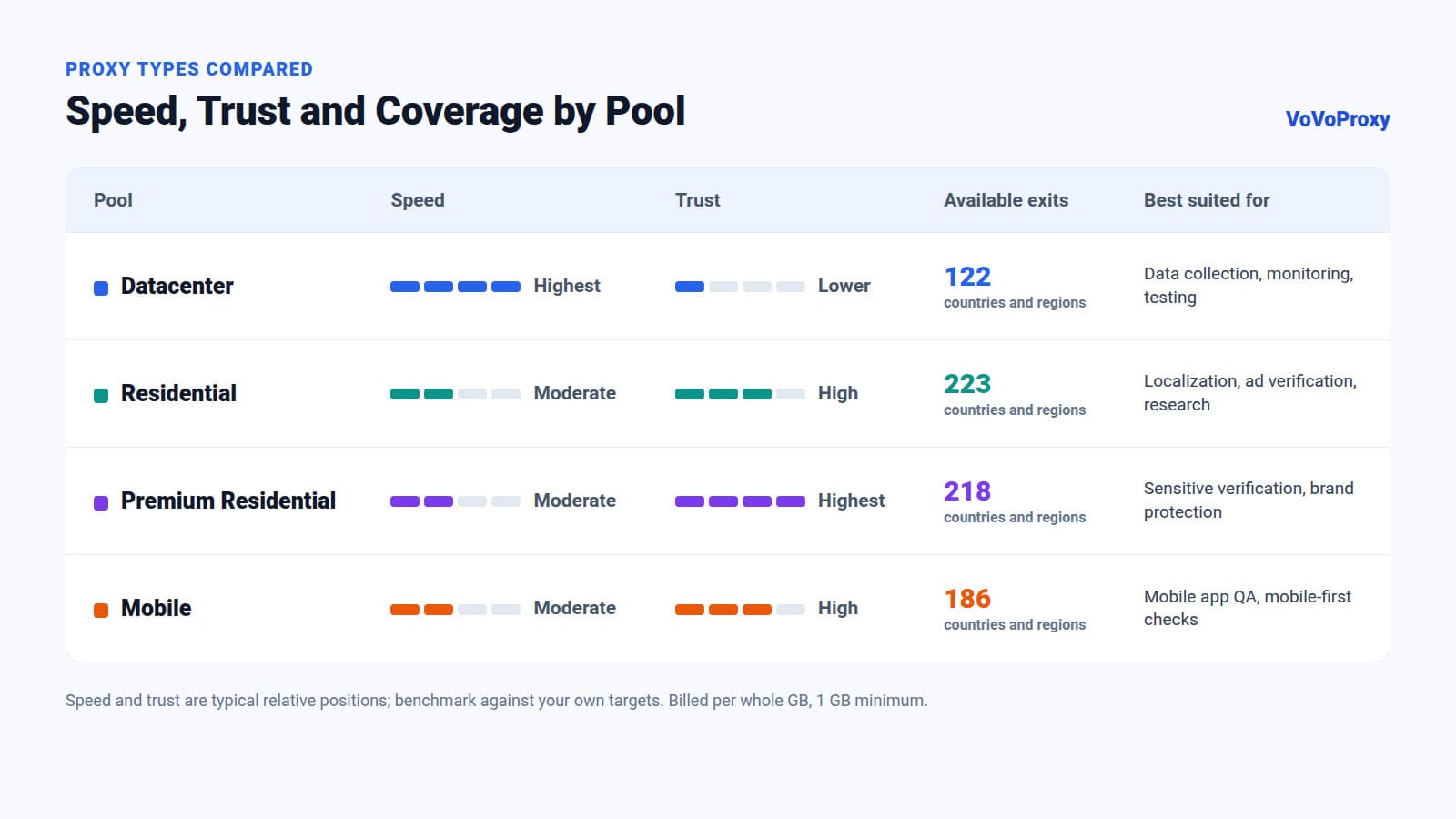
| Pool | Speed (relative) | Trust (relative) | Best fit |
|---|---|---|---|
| Datacenter | Highest | Lower | High-volume collection, monitoring, automated testing |
| Residential | Moderate | High | Localization checks, ad verification, market research |
| Premium Residential | Moderate | Highest (higher-trust pool) | Sensitive verification, brand protection |
| Mobile | Moderate | High (mobile network IPs) | Mobile app QA, mobile-first verification |
A few notes on reading this:
- Speed is relative and target-dependent. Datacenter infrastructure is built for throughput. Residential and mobile connections are generally less predictable. Always benchmark against your real targets.
- Trust is about the destination's view, not about security. All VoVoProxy pools use the same per-account username and password authentication, HTTP and SOCKS5 support, and encrypted credential storage.
- Workload fit is the deciding factor. If the wrong pool forces you to retry, discard inaccurate data, or re-run reports, you waste traffic. Choose the pool that returns usable results the first time.
How billing works
Every VoVoProxy pool is billed per GB from a prepaid balance, so the traffic a job consumes is what matters. Estimate the GB you expect, then check the current per-GB rates for each pool on the pricing page. Traffic is prepaid and deducted from your balance, with a 1 GB minimum and no subscription. Unused traffic stays in your balance, and the portal shows remaining balance and usage history, so you can check real consumption after a test run instead of guessing.
Which Proxy to Choose: A Practical Framework
When teams ask which proxy to choose, these five questions usually settle it.
1. Does the target change what it shows based on who is visiting?
If no, for example public data that is identical for everyone, start with Datacenter. If yes, the content varies by location or visitor type, move to Residential.
2. Does the experience depend on a mobile network?
If you are testing a mobile app, mobile ad placements or carrier-specific behavior, choose Mobile. If a household connection gives you the same result, stay with Residential.
3. How costly is a wrong or inconsistent result?
For bulk monitoring, an occasional retry is fine. For brand protection evidence, compliance checks or sensitive verification, consider Premium Residential.
4. How precise does the location need to be?
Country-level checks are common. City, state or ASN targeting is available depending on the pool, and the countries available are listed in the console. See the pricing page for how targeting affects billing.
5. Does the job need one IP for several steps?
Multi-step flows, such as browsing a product, then a cart summary, usually need a sticky session. Independent samples work best with rotating IPs. Both are supported across VoVoProxy pools. For a deeper explanation, see What Is a Rotating Proxy?.
Quick decision table
| If your job is mostly... | Start with |
|---|---|
| High-volume collection of public data | Datacenter |
| Performance monitoring or automated testing | Datacenter |
| Localization and geo-pricing checks | Residential |
| Ad verification at scale | Residential |
| Market research across regions | Residential |
| Brand protection and sensitive verification | Premium Residential |
| Mobile app QA and mobile-first checks | Mobile |
Mixing pools is normal
Many teams run more than one pool: Datacenter for bulk monitoring, Residential for localized checks, and Mobile or Premium for the cases that need it. VoVoProxy gives you one dedicated account per pool, and you top up each account as needed. That keeps budgets and usage history cleanly separated.
A note on responsible use
Whatever pool you choose, use it for lawful purposes such as data collection, ad verification, localization checks, brand protection and QA testing. Respect site terms, robots.txt guidance and reasonable rate limits. Illegal activity, fraud, spam, malware and abuse of third-party systems are prohibited under the VoVoProxy terms.
How to test before you commit
The most reliable way to settle residential vs datacenter proxies for your use case is a small side-by-side test:
- Pick 20 to 50 representative URLs from your real targets.
- Run them through two pools, for example Datacenter and Residential, from the same target location.
- Compare the results: content accuracy, completeness, response consistency and traffic used.
- Compare efficiency: usable results per GB consumed.
- Scale the winner.
VoVoProxy's 1 GB minimum keeps this test small. Every pool supports HTTP and SOCKS5, and the portal generates ready-to-paste connection strings with the exact host, port and targeting or session parameters. A generic test script looks like this:
import requests

PROXY = "http://USERNAME:PASSWORD@PROXY_HOST:PROXY_PORT"  # copy real values from the portal
urls = ["https://example.com/page-1", "https://example.com/page-2"]

for url in urls:
    r = requests.get(url, proxies={"http": PROXY, "https": PROXY}, timeout=30)
    print(url, r.status_code, len(r.content))
Swap in the connection string for each pool, and keep the request rate modest and within each site's terms.
FAQ
What is the main difference between residential and datacenter proxies?
Datacenter proxies use IPs hosted on server infrastructure, which makes them fast and predictable. Residential proxies use IPs associated with household networks, which gives you a real-user perspective for localization checks, ad verification and market research. Both are billed per GB from a prepaid balance with a 1 GB minimum and no subscription.
Is a mobile proxy better than a residential proxy?
Not in general. Mobile proxies are better when the mobile network is part of what you are testing, such as mobile app QA or mobile-first ad verification. If a household connection gives the same result, residential is usually the better fit.
When should I pay for premium residential proxies?
When an inconsistent or inaccurate result is expensive, for example brand protection evidence, compliance checks or high-value ad spot checks. VoVoProxy's Premium Residential pool is a higher-trust pool.
Which proxy type suits high-volume jobs?
Datacenter proxies offer the highest throughput, which suits high-volume jobs. However, what matters is how many usable results you get, so test against your real targets before deciding.
Can I use more than one proxy type?
Yes. VoVoProxy provides one dedicated account per pool, so you can run Datacenter, Residential, Premium Residential and Mobile side by side, each with its own prepaid balance and usage history.
Do all proxy types support rotating and sticky sessions?
VoVoProxy supports both rotating IPs and sticky sessions, along with HTTP and SOCKS5. The exact session and targeting parameters for each pool are shown in the portal.
Find the Right Proxy Pool for Your Workload
Not sure which pool fits? Create an account, compare pools on the pricing page, and pay with crypto at checkout. Provisioning is automatic, typically within minutes.