Proxies for E-commerce Price Monitoring Across Markets
Price monitoring proxies let e-commerce teams collect public product prices from different markets the way local shoppers see them. Prices, currencies, shipping costs, promotions and stock levels often change by country or region. If you only check from one location, you miss how your products and your competitors' products are actually positioned in each market.
VoVoProxy gives pricing, marketplace and brand teams a straightforward way to run those checks. Choose Datacenter for high-volume collection or Residential for location-accurate views, target by country, state, city or ASN, and pay only for the traffic you use. There is no subscription.
This guide covers what to monitor, how to choose a pool, a reference architecture and how to stay responsible while collecting public data.
What e-commerce teams monitor
Price monitoring is broader than a single number on a product page. Teams typically track:
- Competitor price tracking. Public list prices and discounts for comparable products across retailers.
- MAP monitoring. Checking that resellers advertise your products at or above your minimum advertised price policy.
- Regional pricing. How prices, currencies and taxes differ between markets such as the US, UK and Germany.
- Promotions and bundles. Time-limited offers, coupons shown on the page and bundle pricing.
- Availability and shipping. Stock status, delivery estimates and shipping fees by location.
- Your own storefronts. Verifying that your localized pages show the correct price and currency in each market.
Each of these depends on seeing the page from the right place. A competitor price tracking proxy targeted to the market gives you that view.
Why location matters for price data
Retailers often localize the shopping experience. The same product URL may show a different currency, price, shipping fee or availability depending on the visitor's country or region. Some sites also redirect visitors to a local storefront.
Using ecommerce proxies in each target market helps you:
- Capture the price and currency a local shopper actually sees.
- Compare like-for-like across markets, instead of mixing localized and non-localized data.
- Spot regional MAP violations that would be invisible from your headquarters.
- Confirm your own international storefronts render correctly.
Targeting depends on the pool: country, state, city or ASN, and the countries available for your pool are listed in the console. See the pricing page for how targeting affects billing.
Choosing a pool for price monitoring
Most programs combine two pools: a high-volume pool for bulk collection and a residential pool for accuracy where it matters. Every pool is billed per GB with a 1 GB minimum and no subscription; current prices are listed on the pricing page.
| Pool | Price monitoring role | Strength |
|---|---|---|
| Datacenter | Large catalogs, frequent checks, monitoring your own sites | High throughput and stable session handling |
| Residential | Localized price checks, regional MAP monitoring, market research | Residential network IPs with location-level targeting and broad coverage |
| Mobile | Mobile storefronts and mobile-first price checks | Mobile network IPs with location targeting |
| Premium Residential | Brand protection investigations, sensitive verification | A higher-trust pool for high-stakes checks |
A common pattern is to start with Datacenter proxies for the bulk of routine collection, then use Residential proxies for markets or retailers where the localized view matters. If you are unsure which pool fits, our guide to residential vs datacenter vs mobile proxies walks through the trade-offs.
A multi-market price monitoring architecture
A reliable price monitoring system separates scheduling, collection, parsing and analysis. That makes it easier to scale, debug and control traffic.
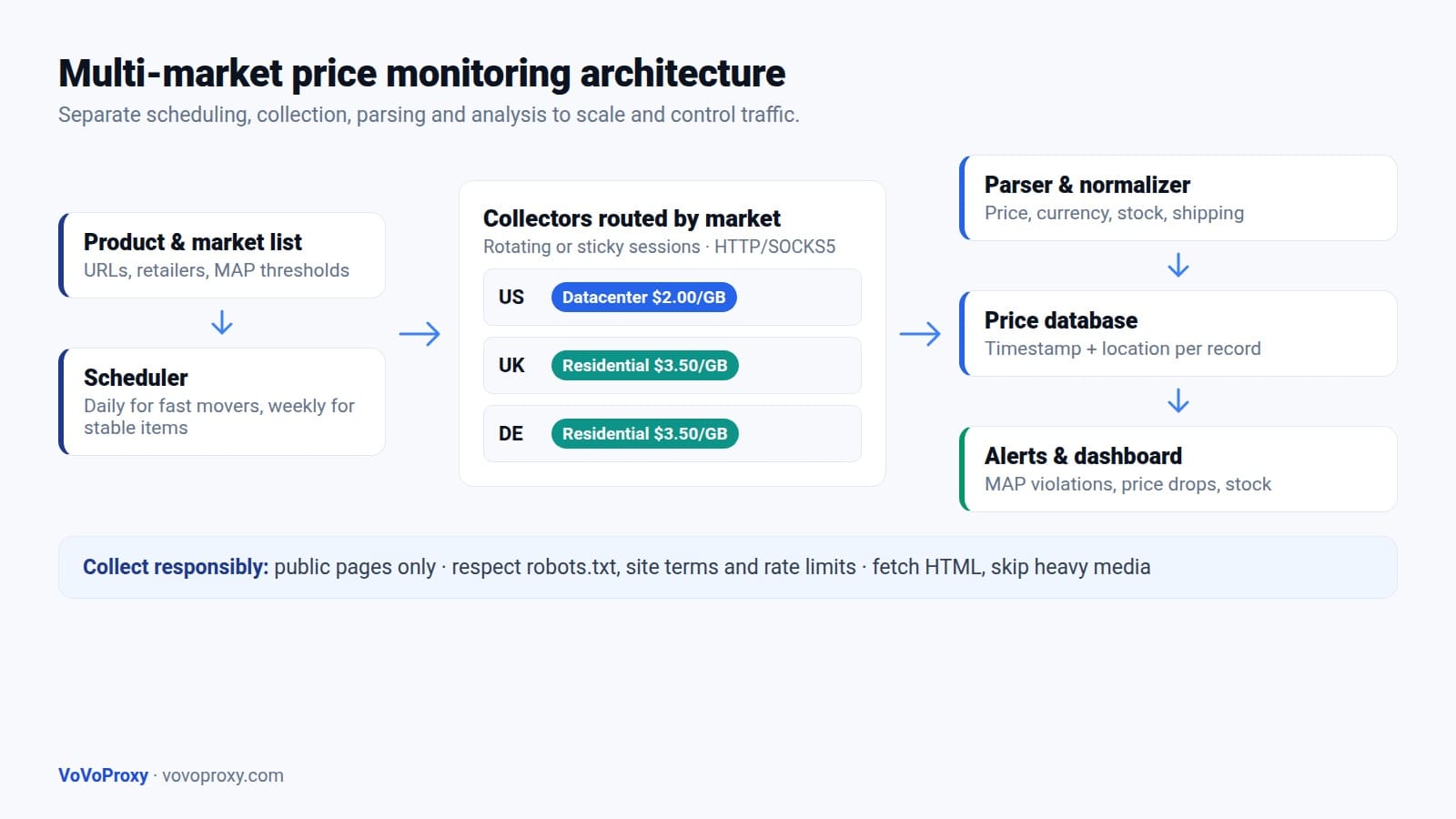
1. Product and market list. Maintain a list of product URLs or identifiers mapped to each market and retailer. Include your MAP thresholds where relevant.
2. Scheduler. Decide how often each product is checked. Fast-moving categories may need daily checks; stable catalogs may only need weekly.
3. Collectors routed by market. Each collector sends requests through a proxy targeted to the right market. Use rotating IPs for independent product checks, and sticky sessions when a check needs several requests from one IP, such as a page that sets the region before showing a price.
4. Parser and normalizer. Extract price, currency, availability and shipping. Normalize currencies and units so markets can be compared.
5. Storage and alerts. Store each observation with a timestamp and location. Trigger alerts for MAP violations, sudden price drops or stock changes.
A minimal Python collector might look like this. The exact host, port and targeting or session parameters are shown in your VoVoProxy portal.
import requests, time

proxy = "http://USERNAME:PASSWORD@PROXY_HOST:PROXY_PORT"
proxies = {"http": proxy, "https": proxy}
headers = {"User-Agent": "PriceMonitor/1.0 (contact: you@example.com)"}

products = ["https://shop.example/product/123"]
for url in products:
    r = requests.get(url, proxies=proxies, headers=headers, timeout=30)
    print(url, r.status_code)
    time.sleep(3)  # pace requests and respect rate limits
HTTP and SOCKS5 are both supported, with per-account username and password and ready-to-paste connection strings in the portal.
Responsible collection and cost control
Price monitoring should focus on public data and respect the sites you visit:
- Collect only publicly available product information. Do not log in to collect data behind accounts or access restricted areas.
- Respect robots.txt, site terms and rate limits. Pace your requests and avoid peak-hour bursts.
- Where a retailer or marketplace offers an official feed or API that meets your needs, consider using it.
- Do not attempt to bypass CAPTCHAs or other security controls.
VoVoProxy is for lawful use only; see our terms.
To keep costs predictable, estimate usage with this formula:
Monthly GB = products x markets x checks per month x average response size
For example, 2,000 products in 3 markets checked daily is about 180,000 requests per month. At 0.1 MB of HTML each, that is roughly 18 GB. Moving one market to Residential for localized checks would use about 6 GB of that total. Measure your own response sizes first, because real pages vary widely.
Tips to reduce GB use:
- Fetch HTML or structured data only, not images, fonts and video.
- Check stable products less often.
- Use Residential only where the localized view changes the result.
- Track spending in the portal, which shows remaining balance and usage history.
FAQ
What are price monitoring proxies?
They are proxies used to collect public product prices and related data from specific markets, so you see the prices, currencies and availability that local shoppers see.
Which pool is best for competitor price tracking?
Datacenter is the usual choice for high-volume collection. Residential is better when you need an accurate localized view of a market. Current per-GB prices for each pool are listed on the pricing page.
Can proxies help with MAP monitoring?
Yes. Proxies targeted to each market let you check public reseller listings for prices advertised below your MAP policy, including regional differences you would not see from one location.
Can I target specific countries or cities?
Yes. Targeting is available by country, city, state or ASN, depending on the pool. US, UK and Germany are available across pools.
Is price monitoring legal?
Collecting publicly available prices is a common business practice, but you should follow each site's terms, respect robots.txt and rate limits, and avoid restricted or account-only data. VoVoProxy is for lawful use only.
How do I pay?
Traffic is prepaid per GB with a 1 GB minimum and no subscription. You choose the pool and volume at checkout, pay with crypto, and your account is provisioned automatically, typically within minutes.
Start monitoring prices across markets
Get a clear, local view of prices in every market you sell in. Create an account, choose the pool and volume, and pay with crypto at checkout.
View pricing and start from 1 GB, with no subscription.