What Is a Rotating (Dynamic IP) Proxy and How Does It Work?
A rotating proxy is a proxy service that automatically assigns a different IP address to your requests, either for each new request or for each new session, instead of sending everything through one fixed address. You connect to a single endpoint, and the service handles the IP changes behind the scenes.
Rotation is one of the most useful features in modern proxy networks, and also one of the most misunderstood. It is not about hiding wrongdoing. Done right, it is about collecting accurate, representative data from many vantage points without overloading any single connection.
This guide explains what a rotating proxy is, how it works under the hood, how it compares with sticky sessions, and how to choose the right setup for lawful work like data collection, ad verification, localization checks and QA testing.
What Is a Rotating Proxy?
Every request you send to a website carries an IP address. With a regular, or static, proxy, that address stays the same until you change it manually. With a rotating proxy, the address changes automatically according to rules set by the provider and by you.
That is why rotating proxies are also called dynamic IP proxies: the exit IP is dynamic rather than fixed.
Rotating vs static proxies
| Static proxy | Rotating (dynamic IP) proxy | |
|---|---|---|
| Exit IP | One fixed address | Changes per request or per session |
| Setup | One address per connection | One endpoint, many addresses behind it |
| Best for | Long-lived connections to a single service | Sampling many pages or locations independently |
| Load on each IP | Concentrated | Distributed across the pool |
| Representativeness | One vantage point | Many vantage points |
Why rotation matters
There are three practical reasons teams use rotation:
- Representative results. If you check prices, ads or search results from one IP, you see one user's view. Rotation lets you sample many views within a target location, which gives a more accurate picture.
- Even load distribution. Spreading requests across many addresses avoids hammering a site from a single connection. Combined with sensible rate limits, it is the more considerate way to run collection jobs.
- Operational simplicity. You manage one connection string instead of a list of individual IPs.
Rotation is a tool for accuracy and scale, not a way around rules. Always respect each site's terms, robots.txt guidance and rate limits.
How a Rotating Proxy Works
Most rotating proxy services follow the same basic architecture: a gateway in front of a pool of IP addresses.
The request flow
- Your client connects to the gateway. You point your script, browser or tool at a single host and port, and authenticate with a username and password.
- The gateway reads your parameters. These typically include the pool, target location and session behavior.
- The gateway selects an exit IP from the pool that matches your targeting.
- Your request goes out through that IP. The destination website sees the exit IP, not yours.
- The response comes back through the gateway to your client.
- On the next request or session, the gateway may select a different exit IP, depending on whether you asked for rotation or a sticky session.
With VoVoProxy, you get per-account username and password authentication, HTTP and SOCKS5 support, and ready-to-paste connection strings generated in the portal. The exact host, port, targeting and session parameters for your pool are shown there.
Common rotation models
Providers implement rotation in a few ways:
- Per-request rotation: each new request may leave from a different IP. Ideal for independent samples.
- Session-based rotation (sticky sessions): the same IP is kept for a sequence of requests, then released. Ideal for multi-step flows.
- Manual rotation: you start a new session yourself when you want a fresh IP.
VoVoProxy supports both rotating IPs and sticky sessions, so you can choose per job.
Targeting and rotation together
Rotation happens within the targeting you set. If you target a country, city, state or ASN (availability depends on pool), the gateway rotates among IPs that match it. US, UK and Germany are available across VoVoProxy pools. That means you can, for example, take 50 independent samples of a product page as seen from one market, rather than 50 samples from random places.
Sticky vs Rotating Sessions: Which to Use
The most important decision you make with a rotating proxy is how long each IP should stay with you. This is the sticky vs rotating sessions question.
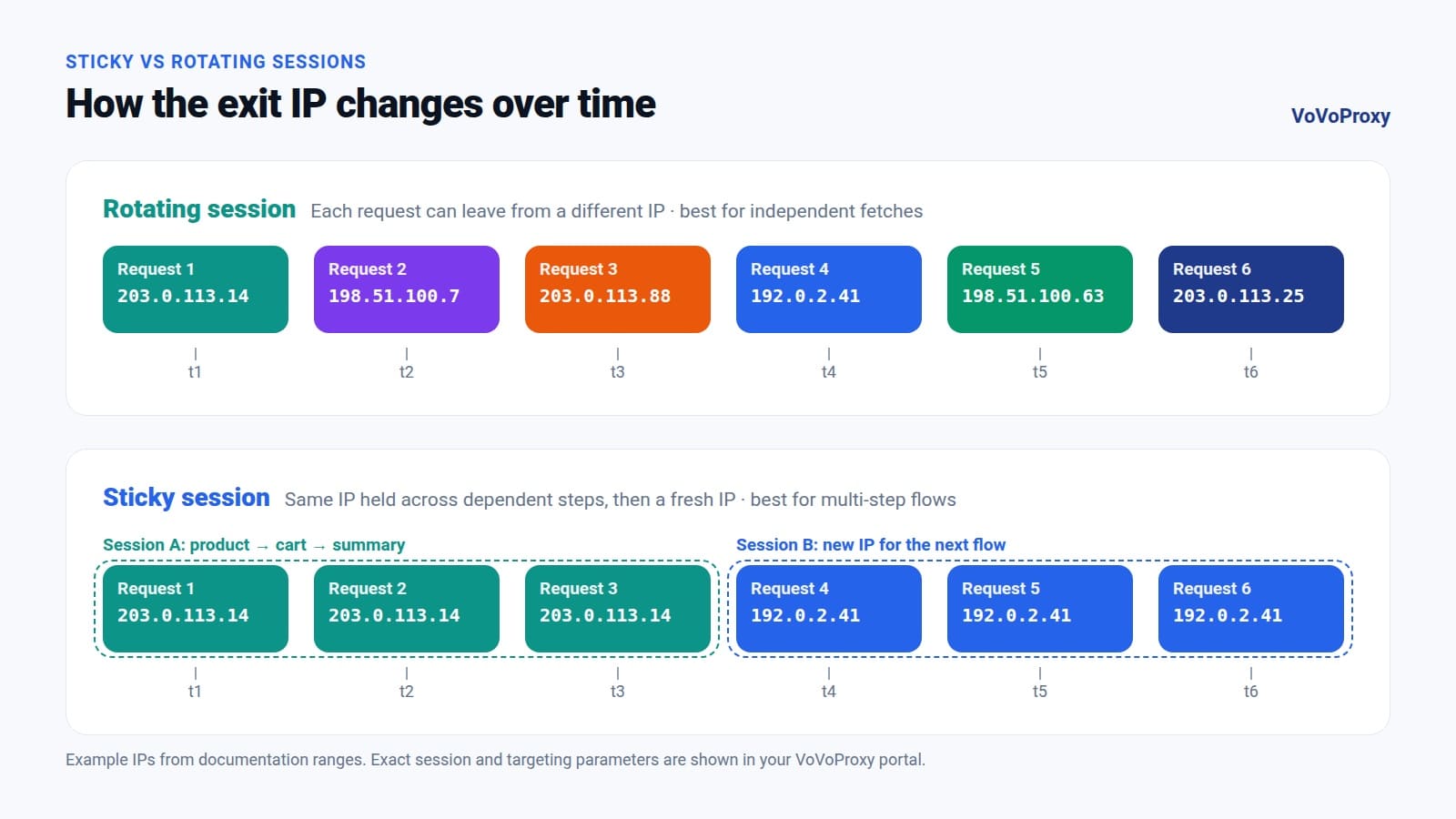
Rotating sessions
In a rotating session, consecutive requests can use different IPs. Each request is effectively independent.
Use rotating sessions when:
- Each page can be fetched on its own, with no login or cart state.
- You want many independent samples, such as checking an ad or price from many vantage points.
- You are monitoring a large list of public URLs.
Sticky sessions
In a sticky session, the same IP is kept across a series of requests. When the session ends, the next one gets a new IP.
Use sticky sessions when:
- The task spans several steps that depend on each other, such as a product page, then a cart summary, then a shipping estimate.
- The site ties state like language, currency or region preferences to the connection.
- You are running QA tests of your own application that require a consistent client identity throughout a test case.
Side-by-side comparison
| Rotating session | Sticky session | |
|---|---|---|
| IP behavior | Can change on every request | Stays the same for the session |
| Best for | Independent page fetches, broad sampling | Multi-step flows, stateful pages |
| Typical use cases | Data collection, monitoring, ad verification sampling | Localization walkthroughs, QA test cases, checkout-flow checks |
| Main risk if misused | Broken multi-step flows | Uneven load on a single IP if you send too much |
| Rule of thumb | Default for stateless jobs | Use only for as long as the flow needs |
A simple decision rule
Ask one question: does request B depend on what happened in request A? If yes, use a sticky session for that sequence. If no, use rotation. Many real jobs combine both: rotate between independent tasks, and stick within each task.
Rotating Residential Proxies and Other Pool Types
Rotation is a feature of the gateway, not of a specific IP type. You can rotate datacenter, residential or mobile IPs. The pool you choose determines what the destination sees and how the job consumes traffic.
| Pool | Best suited for | Rotation fit |
|---|---|---|
| Datacenter | Data collection, monitoring, automated testing | High-volume rotation |
| Residential | Localization checks, ad verification, market research | Rotating residential proxies for broad, location-level sampling |
| Premium Residential | Sensitive verification, brand protection | Higher-trust pool for lower-volume, high-stakes checks |
| Mobile | Mobile app QA, mobile-first verification, mobile network testing | Rotation across mobile network IPs with location targeting |
Why rotating residential proxies are so common
Rotating residential proxies combine two things many teams need: a real-user, household perspective and many vantage points within a target location. That makes them the default for localization checks, ad verification and market research. VoVoProxy's Residential proxies offer location-level targeting and broad geographic coverage.
When to step up to Premium
If your checks are sensitive, such as collecting evidence for brand protection or verifying high-value placements, a higher-trust pool can be worth it. See Premium Residential proxies for when the higher-trust pool makes sense.
Not sure which pool fits?
Our comparison guide, Residential vs Datacenter vs Mobile Proxies, walks through speed, trust and workload fit for each type, with a decision framework.
How rotation affects cost
VoVoProxy bills per GB of traffic, not per IP. Rotating to a new IP does not cost extra by itself: you pay for the data you transfer. Traffic is prepaid, billed per whole GB with a 1 GB minimum, deducted from your balance, with no subscription. The portal shows remaining balance and usage history so you can see what each job used.
Best Practices for Using Rotating Proxies
A rotating proxy is only as good as the way you use it. These practices keep results accurate, costs predictable and your traffic considerate.
1. Match session type to the task
Use rotation for stateless fetches and sticky sessions for dependent steps. Mixing them up is the most common source of broken or inconsistent results.
2. Set targeting deliberately
Choose the narrowest location that answers your question. If you need city-level local results, target the city. If country-level is enough, do not over-constrain the pool. Confirm target locations with the VoVoProxy team during onboarding.
3. Respect rate limits and site terms
Rotation spreads load, but it does not make unlimited request rates acceptable. Keep concurrency modest, add delays, honor robots.txt guidance and follow each site's terms. Never use proxies to bypass security controls or CAPTCHAs, or to abuse third-party systems.
4. Retry carefully
Network requests fail sometimes. Retry with backoff, cap the number of attempts, and log failures so you can tell a temporary network issue apart from a page that is genuinely unavailable.
5. Minimize bandwidth
Because billing is per GB, fetch only what you need. Skip images, fonts and video when you only need HTML, compress responses where possible, and avoid re-downloading unchanged pages.
6. Measure, then scale
Run a small test first. With a 1 GB minimum, you can compare session settings and pools on your real targets before committing to volume.
Example: rotating and sticky connections in Python
The portal generates ready-to-paste connection strings for your pool, including the parameters for rotating and sticky behavior. The example below uses placeholders. Replace them with the exact values from your portal.
import time
import requests

# Placeholders only: copy the real connection strings from your VoVoProxy portal.
ROTATING = "http://USERNAME:PASSWORD@PROXY_HOST:PROXY_PORT"           # rotating session settings
STICKY   = "http://USERNAME:PASSWORD@PROXY_HOST:PROXY_PORT"           # sticky session settings from the portal

def fetch(url, proxy, attempts=3):
    for i in range(attempts):
        try:
            r = requests.get(url, proxies={"http": proxy, "https": proxy}, timeout=30)
            return r
        except requests.RequestException:
            time.sleep(2 ** i)  # back off before retrying
    return None

# Independent samples: rotate
for url in ["https://example.com/a", "https://example.com/b"]:
    r = fetch(url, ROTATING)
    print(url, r.status_code if r else "failed")
    time.sleep(1)  # keep the request rate modest

# Multi-step flow: stick to one IP for the whole sequence
with requests.Session() as s:
    s.proxies = {"http": STICKY, "https": STICKY}
    for step in ["https://example.com/product", "https://example.com/cart-summary"]:
        print(step, s.get(step, timeout=30).status_code)
You can also test the connection from the command line:
curl -x http://USERNAME:PASSWORD@PROXY_HOST:PROXY_PORT https://example.com/For SOCKS5, use the SOCKS5 connection string shown in your portal.
Privacy and data handling
Credentials are stored encrypted. VoVoProxy does not access or store your traffic content. Account, order and usage records are kept for billing, security and support.
FAQ
What is a rotating proxy in simple terms?
A rotating proxy is a proxy service that automatically changes the IP address your requests come from, either on each request or on each new session. You connect to one endpoint and the service handles the IP changes for you.
Is a dynamic IP proxy the same as a rotating proxy?
Yes, the terms are generally used interchangeably. Both describe a proxy where the exit IP changes automatically instead of staying fixed, as it would with a static proxy.
What is the difference between sticky and rotating sessions?
A rotating session can use a different IP for each request, which suits independent page fetches. A sticky session keeps the same IP for a series of requests, which suits multi-step flows where later steps depend on earlier ones. VoVoProxy supports both.
Are rotating residential proxies better than rotating datacenter proxies?
It depends on the job. Rotating residential proxies give a household, real-user perspective for localization checks, ad verification and market research. Rotating datacenter proxies offer high throughput for data collection, monitoring and automated testing.
Does rotating IPs cost extra with VoVoProxy?
No. VoVoProxy bills per GB of traffic, not per IP. Traffic is prepaid, billed per whole GB with a 1 GB minimum, and there is no subscription.
Is using a rotating proxy legal?
Using a rotating proxy for lawful purposes, such as data collection, ad verification, localization checks, brand protection and QA testing, is a common practice. You must respect site terms and applicable laws. VoVoProxy prohibits illegal activity, fraud, spam, malware and abuse of third-party systems.
Start Using Rotating and Sticky Sessions
VoVoProxy supports rotating IPs and sticky sessions across its pools, with HTTP and SOCKS5, per-GB prepaid billing and no subscription. Create an account, choose the pool and volume, and pay with crypto at checkout. Provisioning is automatic, typically within minutes.